Blog

  • Write Through It – Death, Distance, Disappointment

    Write Through It – Death, Distance, Disappointment

    Learning what it means to be enough and how to write through grief

    Last week, I suggested writing through accomplishments, goals, and things that bother you to declutter your mind. The thing bothering me lately is not feeling like I am enough. No matter what I do or how hard I work, it feel like I fall short, and I know I’m not the only one who feels this way. So I wrote about it, and I’ll share at the end of this post. The other thing I was thinking about this week was grief. Not my own, but the grief people I care about are going through.

    Then I realized that grief and “not enough” are deeply tangled. We grieve in “not enough” language without even realizing it. I didn’t say enough. We didn’t have enough time. I didn’t try hard enough. That’s what’s been on my mind lately — and it’s what led me to today’s prompts.

    Don’t stop reading if you think you’re not grieving. Grief comes in more forms than we usually admit. I’m focusing on three, and I think it’s important to learn how to work through grief in all forms so that when big grief hits, and it will, we will have developed coping methods.

    Death is the most difficult because it’s permanent and irreversible. It’s also inevitable. We can’t change it or avoid it, but we can learn to move through it so it doesn’t consume us. If you’ve recently lost a person or a pet, this is your topic today.

    Distance can be physical — you or someone you love moved far away — or psychological — a rift, a withdrawal, a slow drift. Sometimes the distance is even your own doing, but that doesn’t make the grief less real. I believe every time we gain something, we lose something, and the reverse is also true. There is balance, but we have to search for it, and writing can help us find it.

    Disappointment is grieving something you never had. For a long time, I wanted a baby, but it took years. I was teaching high school, watching teenagers grieve unwanted pregnancies, wondering how I could miss someone I’d never met. But I did, and this grief was powerful and real. Other examples: a spouse you can’t seem to find, an elusive promotion, a career or goal that keeps slipping just out of reach. The grief is real regardless of the cause.


    So why write about something that makes us feel sad? Studies show that writing about loss for as little as 15–20 minutes a day for as little as four consecutive days reduces emotional distress and strengthens immune function. Researchers suggest that naming and describing a painful experience gives us cognitive control over it — shifting us from feeling the grief to thinking about it. That’s where healing begins.


    This Week’s Writing Prompts.

    1. Who or what are you grieving? (Is your grief caused by death, distance, or disappointment?)
    2. List one to three things you miss or want most about this person, thing, or concept.
    3. How was/would your life (be) richer, fuller, better with this?
    4. What are you gaining or learning without this?
    5. In what ways do you already have enough, even without this?
    6. How can you keep this alive or reimagined through your own actions, substitution, or creative reinterpretation?

    (If the thing you miss most about a person is her laughter, can you find opportunities to share your laughter with others in her honor? Can you find ways to make other people feel as encouraged and loved as he made you feel? Or, if you want something you don’t have, think about how you believe this would make you feel, and seek that feeling in other ways.)


    If something shows up on the page that you think could help someone else, share it in the comments. Because sometimes our “not enough” is exactly enough for someone else.

    Enough by Konni Atencio

    Enough. What a strangely versatile word. A unit of measure without standards or guidelines. A word flowing between the shores of positive connotation and negative.

    The definition is simple: “Sufficient without excess,” but “sufficient” is entirely uncalibrated. A constantly moving target. Add comparison with others to the equation, and I find myself questioning my own definition of sufficient. Is my idea of sufficient good enough or should I be constantly striving for someone else’s sufficient? Or am I actually striving for someone else’s excess, because if you think about it, it’s usually excess that makes us feel like we are insufficient. The elaborate vacation photos, the glowing successes, the spectacular milestones filling our feeds. Maybe it’s “sufficient” we have a problem with which makes this less of a striving issue and more of a contentment issue.

    We are left to decide, for ourselves, several times a day what constitutes enough. You must decide if you’ve had enough food. Will you leave hungry or over-indulge? What is enough exercise? Will you push yourself to exhaustion or be content with moving your body in the sunshine while inhaling fresh air? Did you get enough sleep? Enough solitude? Enough socializing? Did you do enough work? Did you give enough? Care enough? Listen enough? And every day is a little different, so this is a long way from an exact science.

    Think about the number of everyday expressions using the word “enough.”

    “No, thank you. I’ve had enough.” This is an expression of satisfaction. I’ve had enough food, enough wine, enough fun for one evening. I am full. I am content.

    “I’ve had enough!” A limitation. A line in the sand. I will tolerate no more of this negativity. An assertion. A boundary.

    Parents say it to children when they’re getting wound up. “That’s enough.”

    And then people say to their therapists, “I never got enough…” Usually followed by some sort of psychological nourishment like love, time, attention, credit, value. This “enough” is buried deep, often in shame, as though someone else’s shortcomings are an accurate measure of our worth.

    This can lead to the feeling of “I’m never enough.” And that, too, is often buried beneath mounds of bravado, arrogance, and chipped shoulders.

    Oddly enough, an abundance of lavish praise and high expectations can lead to a similar question: “Why am I never enough?” Perfectionism. Unrealistic goals. The pressure building like lava, ready to explode if we fail to achieve perfection. Or if we fail the people we love, or the people we work for. This one verges on arrogance, perhaps. Because the world won’t collapse if we are simply “good enough.” And yet we’ve convinced ourselves that it might.

    Maybe we do this because “good enough” feels like settling or quitting the race half a mile before the finish line.

    But who decided that your best has to be flawless perfection and a first-place trophy? Why do some of us not know it’s okay to sign up for a race just for fun, with no intention of winning and not a care for who sees us cross the finish line at the back of the pack with the people who are smiling more than sweating? Who told you that the world is going to dissect your every move, looking for flaws? Maybe no one told you this. Maybe it’s the thorn in your side that you must remove and bandage with gratitude for who you are and what you have instead of always needing more.

    Maybe failing to appreciate “good enough” and failing to believe we are “enough” just the way God made us is ingratitude and self-punishment. Maybe it’s just too much worry about self. It’s like painting a wall. In the moment, you notice every tiny flaw, but step back and give the wall a minute to breathe, a little distance and perspective, and it’s good enough. It’s great, in fact, when you stop hyper-fixating on its flaws.

    Sometimes it feels good to say “enough” and to stop pushing and fighting. We say things like, “fair enough” when something is not perfectly fair, not precisely balanced on the scales of justice, but close enough that I’ll give in to what you’re asking. I’ll bend because I’m not too arrogant to see someone else’s logic. And fighting is exhausting.

    Sometimes “enough” feels right and peaceful. Like permission to be okay with who we are today and what we have accomplished. Because there are a whole lot of people in this world who don’t have enough. Not enough food, money, shelter, love, or safety. For those of us who have far too much, I think the answer is to be grateful and to find every opportunity we can to share our abundance with others.

    As for this topic, “Enough is enough”!

  • Write Through It with Me!

    I’ve been thinking a lot lately about why I write. Mostly it’s that when I’m not writing, my brain is more chaotic than usual. Writing helps me declutter my mind, process what confuses and concerns me, plan for the future, and figure out who I am and what I want — because this changes over time, so it’s a never-ending quest.

    Over the years, people have told me they want to write — they feel they have a story in them — but they don’t know where to begin.

    So. Begin here. With me.

    Write Through It is a series of organizational and creative prompts, samples of my own writing, and some research about how writing helps us navigate life — as we live, play, love, worry, and work through it.

    I’m looking for reflective, lifelong learners — people willing to grow and change at any age. Writers who need inspiration. Non-writers who have something to say but don’t know where to start. Anyone carrying something they haven’t yet put into words — because I believe with everything I have that everyone is a writer and everyone needs a way to process their thoughts and feelings. Writing is the cheapest, easiest therapy I’ve ever encountered, and I want to share that.

    I’ll post on Wednesdays. Think “Writing Wednesdays,” but read and write whenever you want to. I hope this becomes a daily habit for you like it finally is for me. Use it however it works for you — it’s yours for free because I miss teaching writing, but I want to do it on my terms and for people who choose it. Not because you’re stuck in English class and you have to pass to graduate!


    Lesson One: Clear Your Mind Before Bed

    First, let’s note that I said I’d post on Wednesdays and this is coming to you on Thursday. Life happens — and that’s probably one of the biggest lessons I’m trying to learn right now. Things don’t always go as planned, but that doesn’t mean I give up. Next week, Wednesday. This week, it is what it is. And that’s okay.

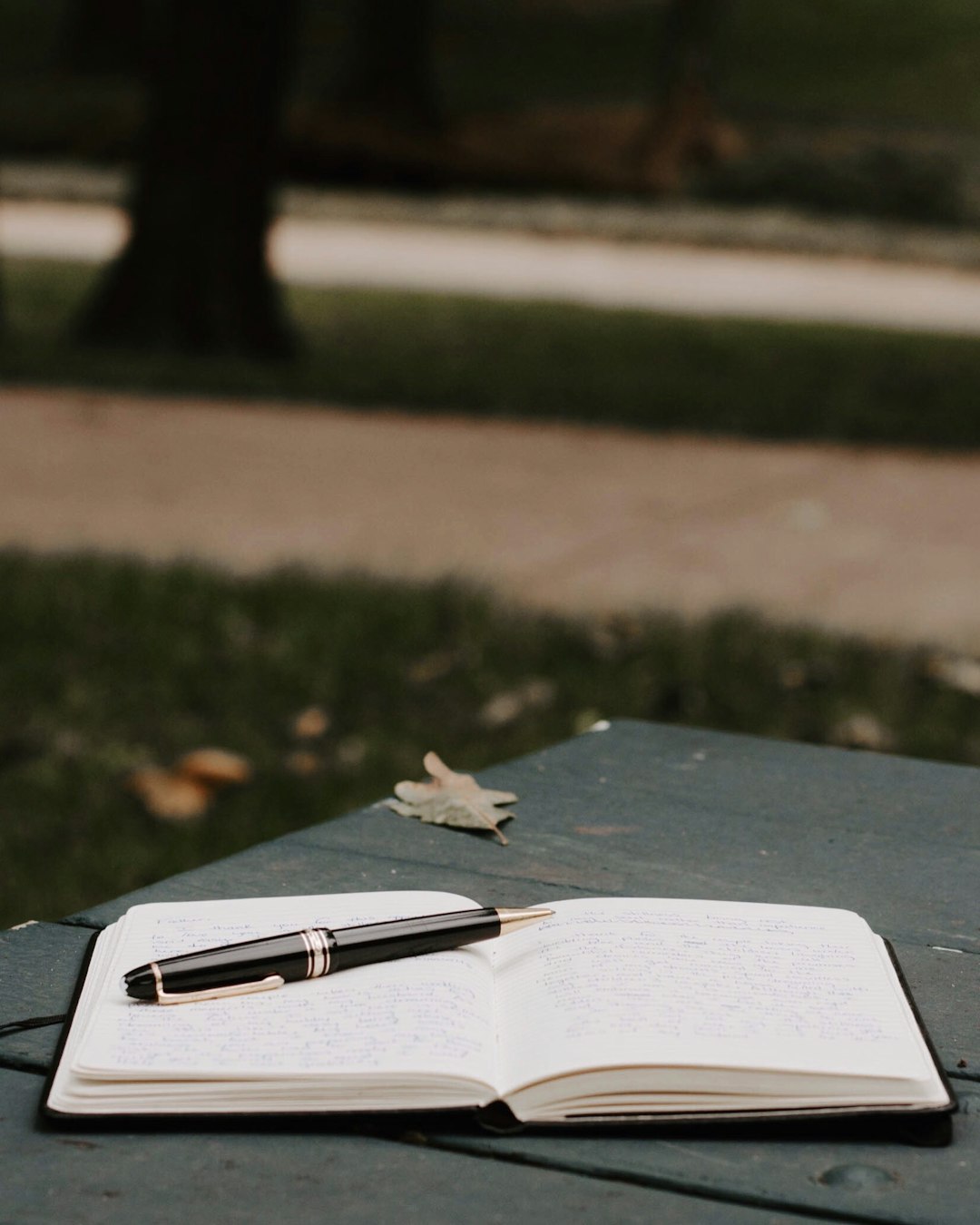
    All you need to be a writer is paper and pen. Research shows there’s something powerful about moving your hand across a page. If you can find a peaceful spot outside to write, even better — nature gives us permission to let our minds wander. Don’t try too hard. Go for a walk first if you need to.

    This first set of prompts is meant for the end of your day — in bed, on the patio, just before you wind down.

    First, start with a list of everything you accomplished today.

    From small things like emptying the dishwasher to big things like finishing a project at work. Don’t forget the things we take for granted — a conversation with a neighbor, smiling at a stranger, listening to someone who just needed to talk. All of these things matter.

    Next, list what you didn’t finish.

    A 2018 Baylor University study found that writing a to-do list of unfinished tasks before bed helped people fall asleep significantly faster — the more specific the list, the better. Instead of letting unfinished business spin around in your head all night, write it down. Now you won’t forget. And now you can sleep.

    Finally, dissect the day’s problems.

    Think high school science lab — I know, gross! Problems left to fester tend to bloat, taking up way too much real estate in our minds. But cut one open and you’ll find that most of your worries are hot air. What’s left is a bunch of little pieces that, once untangled, are manageable. Look for the heart of your problem and throw the rest away.

    If it’s a conflict, you have two choices: have the hard conversation and make peace, or — if that will do more harm than good — let it go. Forgive and move on. If it’s something deeper — a dream you can’t reach, a prayer that feels unanswered — write about what you’d gain and what you’d lose if you finally got there. Because even when we get what we want, we give something up. Then write about what you already have. Spend a moment being truly grateful for exactly where you are right now.

    Psychologist and researcher James Pennebaker, who has studied writing for decades, found that writing about stressful experiences even briefly improves mood, reduces rumination, and frees up cognitive resources.

    Instead of lying awake replaying conversations or beating yourself up for the thing you didn’t do — write it down. Make a plan. You don’t have to fix it tonight. But you can start tomorrow.

    And that’s it. It doesn’t have to be perfect. No one else has to see this but you. Write in sentences, stories, lists — whatever works. This is your daily brain dump so you can sleep well, tackle the hard stuff tomorrow, and still have time left over for the things that make you feel alive.


    If this resonates, subscribe and write with me every Wednesday here and on Substack. Bring a notebook!

    black twist pen and planner
    Photo by Rachel Coyne on Unsplash

  • Teacher Shortage & Teacher Layoffs, Simultaneously?

    Teacher Shortage & Teacher Layoffs, Simultaneously?

    I spend too much of my time wondering how opposite things can be true at the same time. The one bothering me lately is that right now, all over America, schools are preparing to close (a heartbreaking ordeal for staff, students, and parents), experienced teachers are being offered incentives to retire early, and teaching positions are being cut drastically. At the very same time, we are concerned about a very real teacher shortage.

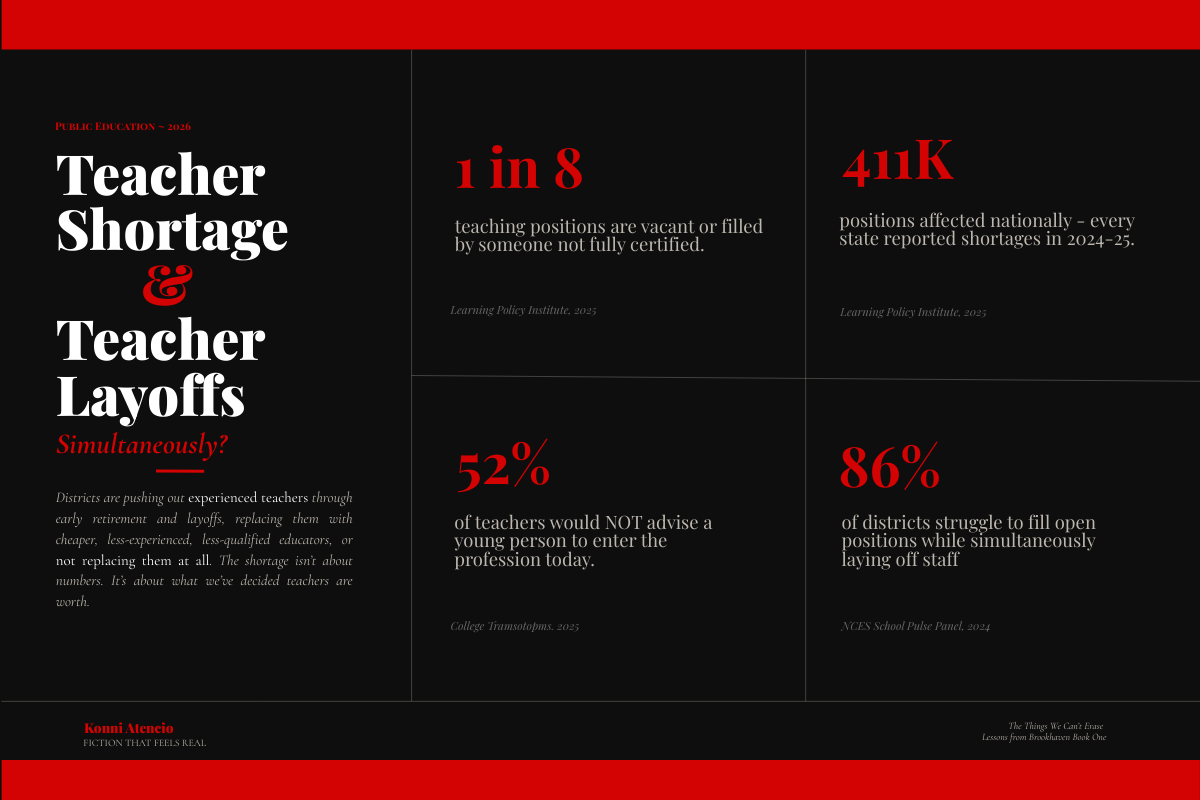
    My logical brain argues that cutting means getting rid of excess, which means we don’t have a shortage at all. Except that I know fewer and fewer high school graduates want to become teachers. So, I did some research. This is not comprehensive because I don’t have months to devote to reading all of the conflicting information out there. Here are some statistics I think people should pay attention to.

    The contradiction in hard numbers:

    • About 1 in 8 teaching positions nationally is either unfilled or filled by someone not fully certified — roughly 411,000 positions, a number that has increased every year. Learning Policy Institute
    • Less than one fifth of teachers leaving the profession are retiring — the rest are leaving for other careers, citing low pay and dissatisfaction. Learning Policy Institute
    • Interest in teaching among high school and college students is at the lowest level in decades. Harvard ended its undergraduate teacher education program due to dwindling interest. College Transitions
    • Only 52% of teachers say they would advise a young person starting out today to become a teacher. College Transitions

    Meanwhile, the layoffs are real and massive:

    • Plans are underway nationally for hundreds of school closures and the layoffs of thousands of staff, as COVID relief funds expire and enrollment declines. World Socialist Web Site
    • San Diego Unified had 965 employees including 478 teachers apply for early retirement incentives. San Francisco Unified cut 535 positions. Santa Ana Unified, after 160 teachers took the early retirement deal, is still laying off at least 100 more. EdSource
    • One critic of this practice wrote: “In my opinion, all incentive funding for teacher training, recruitment and retention should be barred the moment mass layoffs start. Those incentives are a lie and a distortion.” EdSource

    Districts are pushing out their most experienced, highest-paid teachers to replace them with cheaper, less experienced ones — or not replacing them at all. Oakland Unified, for example, is saving money by replacing senior employees at $82,000 average salaries with lower-level employees or simply eliminating positions entirely. The Oaklandside The shortage isn’t a shortage of warm bodies. It’s a shortage of qualified, experienced educators willing to stay.

    Source Articles:

    favicon

    Thousands of California educators issued pink slips again this year | EdSource

    edsource.org

    favicon

    School districts across US announce massive cuts in response to fiscal cliff, as teachers fight to defend education – World Socialist Web Site

    www.wsws.org

    favicon

    Districts Can’t Pay Teachers Promised Incentives After Trump Admin. Cuts Funding

    www.edweek.org

    favicon

    Oakland school district will offer buyouts to senior employees

    oaklandside.org

    favicon

    Teacher layoffs are growing — and won’t be going away anytime soon | K-12 Dive

    www.k12dive.com

    favicon

    Thousands of California Teachers Told They Could Lose Their Jobs – Newsweek

    www.newsweek.com

    favicon

    Massive budget cuts and layoffs announced for K-12 will devastate school districts across the US – World Socialist Web Site

    www.wsws.org

    favicon

    Moorhead Schools offering early retirement incentives ahead of staff, program cuts

    www.valleynewslive.com

    favicon

    Districts offer early retirement. Are students collateral damage? | EdSource

    edsource.org

    favicon

    Teacher Layoffs Are Mounting. How Districts Can Soften the Blow

    www.edweek.org

  • Meet My Imaginary Friends!

    Meet My Imaginary Friends!

    Today, I want you to meet Meredith!

    I change my mind a lot. I change jobs a lot. I move a lot. I am loyal to the people I love, though—I keep them, and I’m grateful they keep me—but when it’s time to change direction, I do. Because I think life is about riding the waves that come, being willing to deviate from the plan, and finding the courage to travel off-path when it makes sense.

    My book launch was scheduled for Valentine’s Day. It seemed right—this book is, in part, a love letter to teachers. But the ebook is ready now. So I’m launching it this Saturday, January 31st. The paperback will still come out on Valentine’s Day (I’m waiting on proof copies), but why make you wait to meet these characters?

    I am thrilled for you to meet characters like Meredith Appleton, who taught me what it means to change course with grace and courage.

    When I write, my favorite characters are the ones who show up and write themselves. They push me out of the way and materialize on the page—like when a tech guru takes control of your computer. Meredith Appleton is that character in The Things We Can’t Erase.

    She’s the perfect blend of compassionate (the ideal first-grade teacher) and gutsy. Smart, experienced, not afraid to stand tall, shoulders back, and tell it like it is.

    Meredith senses disaster long before her new principal, Greg Galloway, sees it. On the first day back for teachers, she warns him in a hushed whisper, careful not to worry the young, inexperienced teachers in the building. “Five of our sixteen teachers are probationary. The district can prune us down to bare branches without even starting up the chainsaw.”

    Later, she stands up to the superintendent in front of the entire staff, “You have ruined this for me, Mr. Stallings. You have made mistakes you cannot erase. You have left scars that will be with me for the rest of my life. You have to live with that.”

    Meredith isn’t afraid to call out people in power when they’re wrong. At the same time, she sacrifices her own security for the sake of her young teaching partner fresh out of college. She could play the seniority card. She could wield her authority over novice teachers. But she doesn’t.

    In one scene, when corruption trickles down to the kids (as it always does), Greg comforts a sobbing first-grader who is clinging to Meredith’s leg. He squats to make himself eye-level with the little boy, then glances up at Meredith “who covered her mouth and looked like she might shatter into a million pieces…Meredith was one of the toughest people he’d ever met, and this was breaking her.”

    That’s when you know the stakes are real. When the toughest person in the room is about to break.

    Meredith taught me that pivoting isn’t about giving up—it’s about knowing when to stay and when to go. When to fight and when to protect someone else by stepping aside.

    That’s why I moved my launch date. Because sometimes you just know it’s time, and waiting feels wrong.

    Want to meet Meredith? The Things We Can’t Erase launches Saturday, January 31st. Preorder here for a special limited-time price meant just for you!

  • Of Rice and Ramen

    Of Rice and Ramen

    Confessions of a Starving English Teacher

    Abby had not planned to be a teacher. She had planned to be a writer, but she became a teacher instead. Not because she wanted her summers off. Though that was a nice perk. Not to accumulate wealth. Which goes without saying. And not because of some pressing need to inspire teenagers. She’d been a teenager herself when she’d chosen her college major, and she knew from personal experience that these were not the most delightful people on the planet. Not even close.

    She became a teacher because her right-brained love of words and need to be creative fell into deep contradiction with the practical, left-sided, “earn a steady paycheck” voices of her parents. When she asked if she could use her college fund to attend writing retreats and find herself, her father said, “I hope you find yourself in college, because that’s where you’re going.” At eighteen, she wasn’t ready to abandon four more years of financial support and, though hard to admit at the time, she took no pleasure in disappointing her parents.

    Okay, so she wouldn’t be a full-time writer. Maybe she could teach writing and write novels in the summer. Never mind the fact that public speaking terrified her. The very idea of standing up in front of a classroom all day made her kneecaps quiver, but what else could she do that would allow her to read and write fiction for a living? The answer to, “What do you want to be when you grow up?” had to be something for which she could be licensed, certified, and gainfully employed. Her parents would not hear of taking chances on something flighty like being a writer. “That’s a hobby, dear, not a profession. What you need most is a steady income with good benefits. A retirement plan and health insurance. You’ll understand one day.”

    Abby moved to Dallas after college. The big city appealed to her, because she, a small-town girl from Athens, Texas where everybody knew everybody, had a lot to prove. She could survive on her own without going back home to marry the boy next door. Her mother had high hopes for this and so did his mother, but Abby figured he was too cool for a bookish nerd like herself. Besides, his handsome face would only distract her from his antiquated views of women through the honeymoon period. After that, she knew she would have regrets.

    No thank you to the homemade quilted picture of Abby returning home to teach for a year or two at her old high school while she planned a quaint little church wedding only to marry some man who would make something of himself while she cleaned his house, diapered his children and cooked his meals. Her old-fashioned parents may have sent her to college to get an MRS degree, but what she learned in college is that she could make a difference, and she could be different. She didn’t need a man or her parents. She could take care of herself.

    Well, she hoped she could.

    By the time she graduated, she had been thoroughly brainwashed into believing the College of Education mantra that meaningful contribution trumped financial compensation. She took a job at an inner-city high school. If her life’s mission was to make a difference, then she would go where the most difference could be made.

    She signed her first teaching contract and divided the annual salary by twelve. She found a studio apartment with a monthly rate she could afford in an area where she felt pretty certain she wouldn’t be mugged or pimped out by a nearby neighbor. It wasn’t a great area, but it had a pool and there hadn’t been a “don’t commit murder” clause in her lease. She’d met a math teacher at New Teacher Orientation who told her this statement existed in his lease agreement. He said he had laughed at first, but then he’d awoken to gun shots a couple of times and he was pretty sure the neighbor below him was dealing drugs. Abby’s apartment was tiny, and she had a long commute, but at least she and her neighbors didn’t have to be told not to kill each other.

    What little money Abby had left in her savings account after college, she spent on rent for July and August. She would not receive her first check until September, even though New Teacher Orientation began the last week in July. The district paid once a month, on the first, and they weren’t about to send paychecks for three days’ worth of orientation meetings. Those three days were included in her salary, and she would be paid for them and four weeks of teaching in August on her September check. New teachers were pretty much screwed. She was hungry by the time that first check arrived. Genuinely hungry. She had eaten nothing but Minute rice and ramen noodles for an entire month.

    When she opened the email that contained her first check stub, she cried. And not tears of joy, either. She dripped a tear or ten right there in her classroom, thankfully during her prep period so no one witnessed this scene. She managed to pull it together before her next class started, but in her car on her way home, she outright sobbed.

    Had her parents actually believed she would be able to support herself on a teaching salary? Again, her mother’s voice. “Well, it’s not a lot of money, but it’s a perfect second income, and one day when you have children, you’ll be home with them in the summers.”

    Except that Abby didn’t have a husband or children, so this was not her second income. It was her only income, and to call it income might be a gross exaggeration. The only thing grosser than her gross pay was her net pay. Boy, had that been a shocker. She had not been prepared for Uncle Sam’s greed. Could she really call him an uncle if he could look at her measly paycheck and dare to take such a cut? No. Not Uncle Sam. More like Son of Sam.

    Abby knew they would take out taxes, but why so much? And that health insurance was not free. Not at all. The school district deducted five-hundred of her meager dollars for premiums to buy insurance that would cover only 80% of her expenses AFTER she met the $5000 deductible. She learned this from a co-worker who had to put her children on Medicaid because she couldn’t afford the family plan which cost twice what Abby had to pay. Abby had to Google words like “deductible” and “premiums” because she, at 22, knew nothing about health insurance. She also logged into the school district’s website to see if she could opt out of the health insurance plan. This “benefit” had just become a luxury she could not afford.

    She should have leased an apartment in the more affordable no-murder-clause part of the city, but she’d signed a twelve-month lease not realizing her slightly safer studio was too rich for her blood. Why hadn’t she majored in business like her brother so she could pay the rent AND buy actual food instead of her nightly ritual of unfurling another block of tangled strands of defeat in a pot of boiling water?

    Good thing she’d spent four years learning educational ideals instead of honing her writing craft. Being a starving artist would really suck.

    She dumped her rubbery noodles from her one pan into her only clean bowl, rinsed off a fork, and went outside to sit on the concrete floor of her second-story balcony to contemplate life while soaking up the sounds of the city as the sun set on another day. Despite herself, a slow smile lifted the left side of her mouth. Here she was, hungry and overwhelmed, but living life on her terms. Sort of. Not living up the street from her parents, not giving in to the pull of an easier life in a familiar setting, though some days the temptation overwhelmed her.

    “Hey, Abby!”

    Abby looked down to see her new friend, Becca, an elementary teacher who lived in her building. Becca waved and smiled. Abby returned the wave.

    “Ramen noodles again?” Becca asked, looking up at Abby from the courtyard.

    “I’m pretending it’s lo Mein from my favorite Chinese restaurant, but my tongue isn’t believing the lie.”

    Becca laughed. “Want to go for a walk later?”

    “I would love to, but I have two more stacks of essays to grade before tomorrow when I get to assign another one.”

    Becca shook her head. “English teachers are gluttons for punishment. Maybe tomorrow?”

    “Definitely,” Abby answered with a smile. She was grateful to have a friend, and frustrated that it took her fifteen minutes to grade every essay. Two more stacks would take almost three hours, and she was exhausted from teaching all day. She didn’t know what else to do, though. The kids deserved to have feedback on these essays in order to improve on the next round. Abby felt like her work never ended. She wanted to finish her grading at school, but she only had one forty-five-minute planning period each day, and most days, that time was filled with unproductive meetings that could have been emails.

    Abby spent her days trying to make her students settle down, get quiet, listen up, but she didn’t have a clue about classroom management. “Say it with authority,” said the teacher in the room next to her. This made Abby laugh. What authority? She was four years older than her students, and none of them believed those four years gave her an ounce of authority. Most of them had siblings older than Abby.

    One particularly bad day, the football coach caught her crying in the teachers’ lounge. “You just gotta’ fake it ‘til you make it,” he said. “The first year is hard. It gets easier.”

    Abby had no idea how to fake it. She didn’t really even know what “it” was. That day, a student had told Abby to f-off when she asked him for his homework. She sent him to the principal, who sent him immediately back to class with a victorious sneer. The assistant principal came to her room during her prep period and explained that the boy—a six-foot, two-hundred pound boy—has anger issues and his parents have sued the district before. “He doesn’t like to do homework. We have kind of an, um, understanding with his parents. Just let him be, okay?”

    Really? Abby thought. Nobody likes homework, but if it’s optional for this kid, why would anyone do it? And if they don’t do homework, how will they learn what I’m teaching? And if they don’t learn, am I really teaching? So much for making a difference. Abby felt disheartened and chastised. She also felt scared. This big, intimidating kid had just won a battle she’d picked. Would he walk all over her now? Was she safe in her own classroom? Would anyone defend her if this kid decided to come at her?  

    The next day, Abby asked the veteran teacher across the hall if he could offer any tips on classroom management. “Don’t smile until Christmas,” he said, hurrying off to make copies before the morning bell. Well, Abby had that one down pat. She couldn’t remember the last time she’d smiled. Most days she went home and cried, wondering why she didn’t chuck it all and apply for a job peddling fruit-infused lotion at the mall.

    Speaking of Christmas, Abby had never been more excited to go home for the holidays where she would devour whatever food her mother made without complaint. She’d become a lot less picky and her parents seemed noticeably smarter than she remembered. Maybe getting punched in the face by the world she was going to conquer had given her a new appreciation for her parents. At the end of her break, she returned to her apartment with a cooler full of home-cooked meals and a bag of canned goods. She shoved a case of ramen noodles and a box of rice to the back of her small pantry to make way for soup, peaches, and beans. Once upon a time, she would have turned up her nose at canned food. Now she was thrilled for some variety in her diet.

    Abby prepared for another week of teaching, armed with pep talks from her family who still believed in her ability to make a difference. New semester, new energy. But she returned to the same old classroom with its dirty windows and rickety desks. Her students were sleepy, apathetic, and mad about having to leave their phones in their lockers. They were dopamine addicts going through TikTok withdrawals. They needed help, and so did Abby.

    She considered seeking counseling or even medical attention for the ulcers worn into the lining of her stomach by the stress of the job for which she was ill-equipped, but she had opted out of the health insurance plan in September, and she sure couldn’t afford therapy without it.

    Hanging on by a thread, Abby started counting down to summer break on the last day of spring break. It was too soon, but thoughts of summer distracted her from worries that her students would not perform well on upcoming state and district tests. Would she lose her job if her test scores were low? She had no idea, so she focused on summer break.

    Abby dreamed of sleeping late and tanning at the apartment complex pool—an amenity for which she paid every month and intended to utilize. That is until the end of April when her landlord announced a rent increase. The only way to afford her current tiny apartment would be to get a summer job. Abby would not be sun tanning and writing stories. Nope. So much for that.  

    Abby signed up to teach six weeks of summer school to students who hadn’t cared to pass her class the first time. They’d spent nine long months ignoring her assignments and mocking her attempts to motivate them. Wouldn’t they be thrilled to spend six more weeks with her during what should have been the most joyful season of the year? She could hardly wait.

    The summer school principal looked defeated and worn out, like a man running the last three miles of a marathon toward retirement. “Here’s the deal with summer school,” he said as he walked her down the hall toward her classroom. “The kids are pissed about being here, and the parents are pissed about having to pay for a ‘free public education’ that their hard-earned tax money already paid for.” He rolled his tired eyes. “It does no good to remind them that if their kid had passed the first time he took the class, the credit would have been free. Anyway, this is credit recovery and babysitting. Everyone passes. Got it?”

    Abby nodded, but everything in her disagreed with this broken system. It had taken less than one calendar year to strip her of the “change the world” fairy dust the college of education had heaped upon her. Less than one year to understand why her colleagues often grumbled about being nothing but glorified babysitters.

    She dragged herself into a room full of apathetic scowls. Three boys sat in the second row and propped their feet up on the empty front-row chairs because no one cool enough to fail English was nerdy enough to sit in the front row. Two of them proudly displayed police-issued, house-arrest ankle bracelets. They tried to shock Abby with their tales of delinquency, but Abby could only lament that the school building fell inside the bracelet monitoring radius. These boys were there to heckle, not to learn. Apparently learning was not on the summer school menu, anyway. No learning, no teaching. Easy credits, easy money. It felt so wrong.

    The morning after the last day of summer school, Abby pulled her hair into a ponytail, laced up her running shoes, put in her earbuds, and stepped outside into a humid July sunrise. She had survived her first year of teaching and she had endured what she hoped would be her last session of summer school. Abby had two weeks to herself before starting her second year of teaching.

    Abby took a long run, wiped the sweat out of her eyes, and returned to her new apartment, one in between the murder clause district and the added cost for amenities complex. One she could afford without teaching summer school. Abby’s phone beeped to alert her of a new email. Next year’s rosters were out. Abby scrolled through her list of students. She recognized some of the names. Some repeats from her junior classes that she would have again in her elective senior literature class called Tone, Irony, and Unforgettable Characters. She smiled. These were some of her favorite kids, and they had chosen to take her class. They had chosen her.

    And she would show up for them.

    She took a shower and boiled a pot of water. Rice, again. She’d decided to take the health insurance this year with her two percent cost-of-living increase, which meant another year of rice and ramen, but she’d learned to dress it up with black beans and feta crumbles for protein. The jury was still out on whether or not she could dress up teaching enough to make a real difference in a broken system, but she would give it her all for one more year and reassess in May.

    Abby curled up on her couch, picked up her favorite Steinbeck novel and read the Robert Burns quote on the dedication page. “The best laid plans of mice and men often go awry.”

    “You got that right,” she said to no one at all. She chewed her rice and laughed.
  • Broken Glass and Sunny Meadow Lane

    Broken Glass and Sunny Meadow Lane

    Story Behind the Story – Breaking Together

    One of my favorite reviews for my first novel Breaking Together was written by a reader named Ruthie. She said, “Sometimes in a book you discover a character you would truly like to have for a friend or live next door to in reality…Maggie is such a character as she is so real…”

    Maggie is a no-nonsense woman in her seventies who plays the role of mentor to the novel’s protagonist, Nichole. In the story, Maggie owns a stained-glass shop on Main Street in a town called Rainbow Falls where she makes masterpieces from broken glass.

    When I first wrote this novel, my daughters were nine and eleven, and I was a stay-at-home mom. In a brief span of time, three of the moms whose children attended the same neighborhood elementary school as my kids, unexpectedly lost their husbands to car accidents or health issues. I watched these women and their children struggling to survive without their husbands, without their dads, without their primary sources of income, and I wondered if I would have the courage to keep moving through that kind of grief. Could I hold my family together if our world fell apart?  

    So, to untangle my fears, I wrote about them.

    At the time, we lived on Sunny Meadow Lane in Grand Junction, Colorado, and that street was as idyllic as it sounds and a perfect place to raise kids. A brick house filled with natural light on a quiet cul-de-sac with enormous trees in a grassy yard. It was the kind of neighborhood where people knew and cared for each other.

    One neighbor, Jim Dible, loved to make stained-glass art, and he generously offered to teach me his craft. He had some extra supplies, and he gave me everything I needed to make my own creations. I still have those tools, and I think of Jim every time I use them.

    Because I was learning this new hobby while writing Breaking Together, my mind often slipped into stained-glass lessons as I wrote. Like glass, people break. We shatter and we heal. We are left with scars, but we gain depth and complexity through our suffering. I wondered about the purpose of suffering even as I intentionally broke perfectly beautiful sheets of glass into smaller pieces.

    It made sense from an artist’s perspective. The glass was pretty by itself, but how much more stunning could it be if I nestled a piece of yellow into pink petals and shards of green to make a flower rich with various textures, colors, and opacities? That glass had so much more potential in conjunction with other glass than it did as a monochromatic sheet, but first, I would have to break it. I would have to weaken it by scraping and cutting its protective glaze. I would apply pressure until it cracked and split along those cuts. I would spend hours grinding off the sharp edges with gentle but constant pressure against a hard metal cylinder coated in diamond bits. I would grind each piece until they fit together, each complimenting the next. Grind, fit, grind, fit, until two, three, four pieces of broken glass came together to make something more beautiful than they ever could have been if left intact.

    Then, I would take each piece, its sharp edges now smooth and harmless, and wrap those edges in copper foil. This is a gentle, meticulous process. One piece at a time, wrapped in shiny copper tape, framed as a reminder that its individuality mattered even as it became part of a collective. When each piece was wrapped, I would pin them all together again and hold them tight with tacks on a fire-resistant board, and I would use a hot soldering iron to melt silver onto the copper, closing the tiny gaps between the pieces. Finally, the work—the pressure and the heat—would end. I would lovingly polish the glass and the solder scars as I let my tense shoulders relax. I would hang the finished piece in a sunny window, step back, and watch in awe as the solder lines faded into the kaleidoscopic brilliance.

    I framed my novel with these lessons, and I needed a character to teach the lessons. Slowly, Maggie stepped into my imagination. I pictured her as a spry woman. No nonsense. Creative but in the most practical sense. Not a free-spirited hippy, but an artist tapping into her creativity to heal her wounds. One who hid her heart beneath a feisty exterior and a barely visible, nearly impenetrable layer of clear glaze. A woman who believes in God, but who doesn’t always understand Him and isn’t afraid to ask questions. A woman who allows her sharp pain to be ground into smooth compassion, though not without some stubborn resistance.

    Maggie took on a life of her own. I didn’t have to plot or plan or decide what Maggie would do or say. Maggie told me. When I wrote her scenes, my fingers flew across the keyboard.

    To this day, I often hear Maggie’s voice in my head, motivating me with practical, straightforward wisdom.

    When my daughters started high school, we built a house closer to their school, and we left Sunny Meadow Lane, but I never stopped missing that house. I’d called it my “forever home,” and our new house never had that same feeling for me.

    The girls both graduated from high school and moved out. We made it through their childhood without losing their dad, and for that I am grateful. I try not to take that for granted, because I know well this is not true for all kids. Eventually, the girls moved to Dallas, and our house began to feel too big and too empty. Meanwhile, I’d decided to update Breaking Together and the rest of this series, which made me nostalgic for my Sunny Meadow days.

    One weekend, we went to visit the girls, and on a whim, we decided to look at a lake house. We pulled up, and there it was. A brick house filled with natural light at the end of a quiet cul-de-sac with enormous trees in a grassy yard. The kind of neighborhood where people know and care for each other. The kind that instantly felt like home. Of course it did. It was Sunny Meadow Lane on a lake. In Texas.

    Everything happened quickly after that, and we moved. One of the first people I met in our new neighborhood is a woman I will call Cecelia. One of the first things she told me about herself is that she makes stained-glass art. The next thing she made clear is that she is a firm believer in God, even when she doesn’t understand Him. She makes no apologies for who she is, and she tells her truth even if it’s not the popular answer. She’s spry and active, sharp and busy, spiritual and gritty. There are sharp edges in her backstory, but that doesn’t keep her from spreading joy to her neighbors. She’s the solder that binds us together. Our street is a neighborhood because of Cecelia.

    It’s like Maggie came to life in Cecelia, and I get to “have her for a friend and live next door to her in reality.” I wish I knew my reader, Ruthie, so I could introduce her to Cecelia to make her wish to know Maggie come true in a strange, mysterious way.

    I continue to marvel over the fact that a fictional character came to life in my mind in 2011 and in 2024, I felt like I met her in person. I don’t understand all of this, but I believe it is part of a bigger plan. I believe everything fits together like pieces of broken glass. Our mistakes, our failures, our successes, our wins, our losses…all of it might look like individual shards that mean nothing except that they cut us deeply or brought us momentary pleasure, but I am convinced that if we look closely enough, if we pay attention to the details of our lives, we can see how these pieces are deliberately arranged to create one small portion of a vast masterpiece known as the human existence.  

    I love that a fragment of my life lies next to a piece of Jim’s, and Ruthie’s, and Cecelia’s and that our pieces are soldered together by a fictional character named Maggie. I love that all people leave behind a legacy of broken, imperfect fragments that are made perfect by the pain and pressure required to soften our edges so that we fit perfectly next to other people whose edges match our own. People entirely different from ourselves but to whom we bond because we share similar experiences and struggles. I believe the human experience is about finding beauty in brokenness, clarity in chaos, and magnificence in minutiae. When we learn to do these things, we will understand how to stop falling apart and begin breaking together.

  • The Story Behind the Hanging On Series

    The Story Behind the Hanging On Series

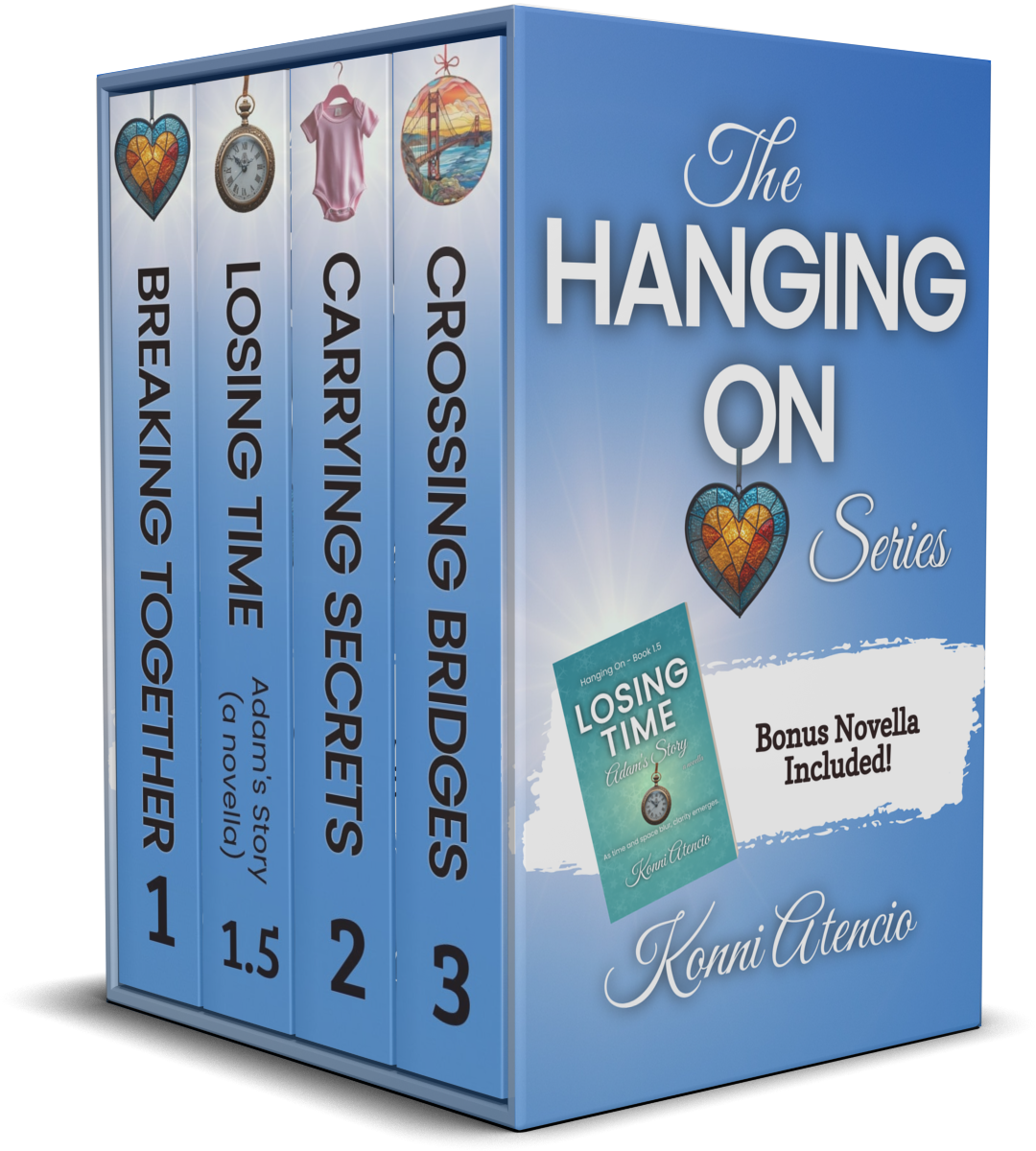
    I initially wrote this series a decade ago when I was a stay-at-home mom raising my two daughters. Breaking Together (originally Broken by Design by a lovely publisher and a dreary cover!came into existence because in a short span of time three of the moms who had kids at the same elementary school as my kids, unexpectedly lost their husbands. This scared me. I had put my teaching career on hold to raise the kids. If I lost my husband, what would we do? How would we survive? I used fiction to explore this and to ease my fears.

    Carrying Secrets was inspired by a couple of stories of girls in our community who gave birth and hid their babies. As the mother of daughters, I wondered if my girls knew they could trust me with an unexpected pregnancy. I wondered how I would handle the situation. And I explored the idea of abortion versus keeping the baby (a hot election topic at the time) from a different perspective.

    I wrote Crossing Bridges to wrap up the series. I felt like book two left Nichole and Emma hanging a bit, and I wanted to finish their story. However, just as I was finishing this novel, I had the opportunity to go back into teaching on a part-time basis. It seemed like a good way to ease into the workforce, so I rushed this book the first time. I have spent the last couple of years (while working full time) revising this series. Crossing Bridges received a major overhaul, but, much like building a new house versus remodeling an old one, this was an arduous process. 

    Losing Time is what I call a “vessel story.” Sometimes, when I’m smart and patient, I pray first and then let words and ideas flow from that. One of my dearest friends lost her dad very suddenly, and this made me wonder, more speculatively than Scripturally, if the spirit of those we lose sticks around for a while to ease us into adjusting to life without them. I wonder, too, if we will one day gain a heavenly perspective which allows us to see how even the heartaches, mistakes, and losses all belong in this beautiful masterpiece that is not just our own lives, but all of creation. Mistakes and death are part of the picture, and maybe the beauty of eternal living is the absence of time and space. This free novella allowed me to explore these ideas, and it helps bridge the time gap between Breaking Together and Carrying Secrets while also introducing readers to Desiree who is the protagonist of book two but who did not appear in book one. 

    Well, that was a lot! I’m wordy! But I hope this helps you to understand where I was coming from with this series. 

    I would love to connect with you! Feel free to reply to this email. Or, if you enjoy the books and have a minute, a review on Amazon would be super helpful. Here’s the link, and thank you, again, for your purchase! 

  • Calling All Teachers!

    Calling All Teachers!

  • Semicolons Copy

    Semicolons Copy

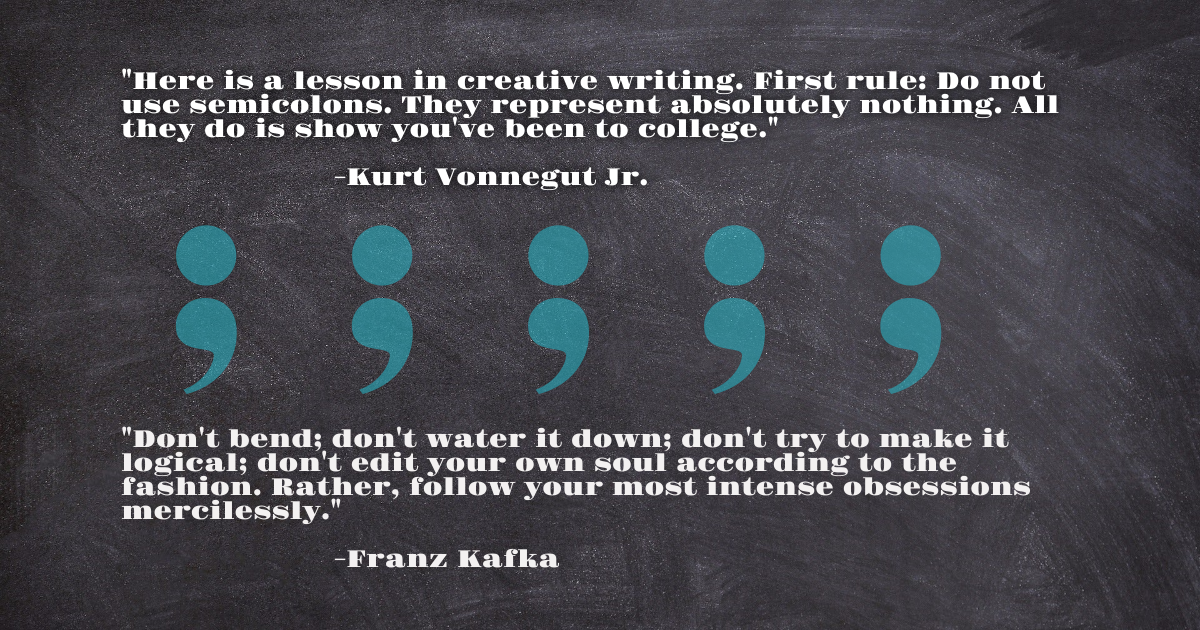
    I am not a big blogger. I may use this in the future for character sketches. I will also use this space to post things about writing and life that make me laugh. Irony is always a good source of humor in my book.

    I found these quotes about writing in this exact order. Coincidence? I don’t know, but it made me giggle, and I’m always up for that.

    The form you have selected does not exist.

Verified by MonsterInsights