Confessions of a Starving English Teacher
Abby had not planned to be a teacher. She had planned to be a writer, but she became a teacher instead. Not because she wanted her summers off. Though that was a nice perk. Not to accumulate wealth. Which goes without saying. And not because of some pressing need to inspire teenagers. She’d been a teenager herself when she’d chosen her college major, and she knew from personal experience that these were not the most delightful people on the planet. Not even close.
She became a teacher because her right-brained love of words and need to be creative fell into deep contradiction with the practical, left-sided, “earn a steady paycheck” voices of her parents. When she asked if she could use her college fund to attend writing retreats and find herself, her father said, “I hope you find yourself in college, because that’s where you’re going.” At eighteen, she wasn’t ready to abandon four more years of financial support and, though hard to admit at the time, she took no pleasure in disappointing her parents.
Okay, so she wouldn’t be a full-time writer. Maybe she could teach writing and write novels in the summer. Never mind the fact that public speaking terrified her. The very idea of standing up in front of a classroom all day made her kneecaps quiver, but what else could she do that would allow her to read and write fiction for a living? The answer to, “What do you want to be when you grow up?” had to be something for which she could be licensed, certified, and gainfully employed. Her parents would not hear of taking chances on something flighty like being a writer. “That’s a hobby, dear, not a profession. What you need most is a steady income with good benefits. A retirement plan and health insurance. You’ll understand one day.”
Abby moved to Dallas after college. The big city appealed to her, because she, a small-town girl from Athens, Texas where everybody knew everybody, had a lot to prove. She could survive on her own without going back home to marry the boy next door. Her mother had high hopes for this and so did his mother, but Abby figured he was too cool for a bookish nerd like herself. Besides, his handsome face would only distract her from his antiquated views of women through the honeymoon period. After that, she knew she would have regrets.
No thank you to the homemade quilted picture of Abby returning home to teach for a year or two at her old high school while she planned a quaint little church wedding only to marry some man who would make something of himself while she cleaned his house, diapered his children and cooked his meals. Her old-fashioned parents may have sent her to college to get an MRS degree, but what she learned in college is that she could make a difference, and she could be different. She didn’t need a man or her parents. She could take care of herself.
Well, she hoped she could.
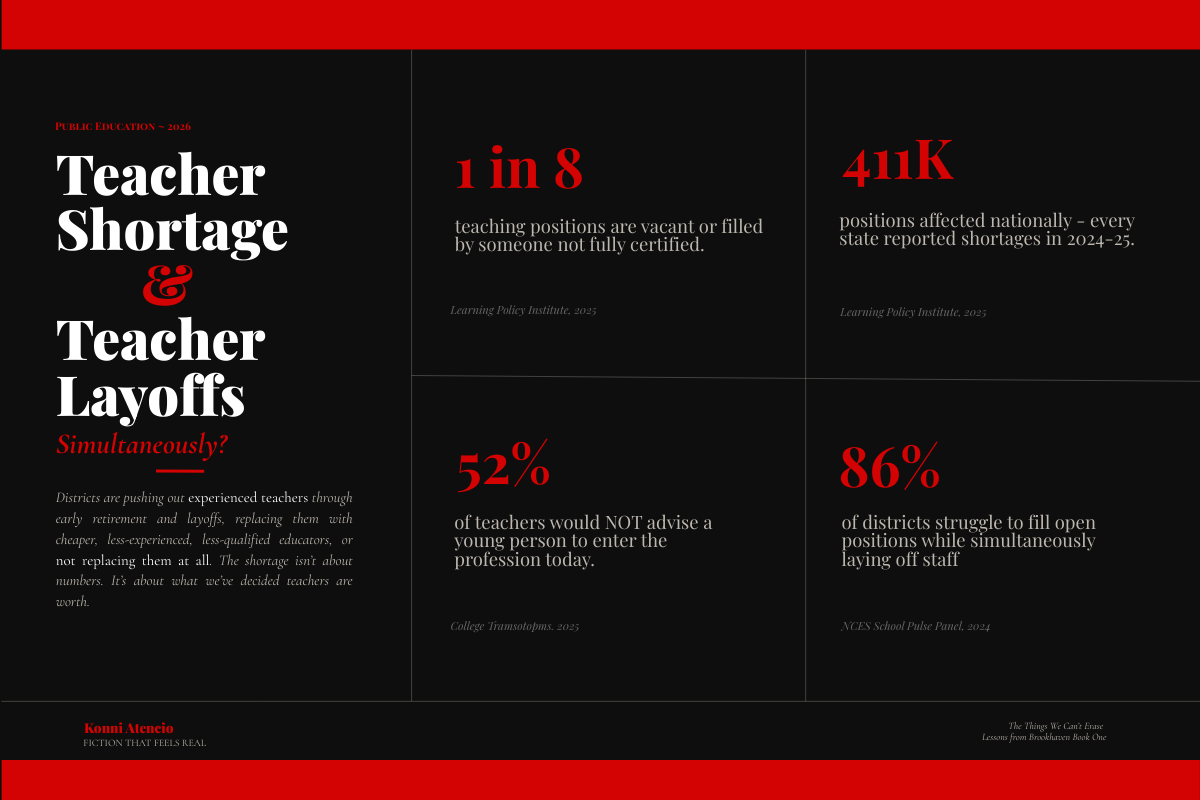
By the time she graduated, she had been thoroughly brainwashed into believing the College of Education mantra that meaningful contribution trumped financial compensation. She took a job at an inner-city high school. If her life’s mission was to make a difference, then she would go where the most difference could be made.
She signed her first teaching contract and divided the annual salary by twelve. She found a studio apartment with a monthly rate she could afford in an area where she felt pretty certain she wouldn’t be mugged or pimped out by a nearby neighbor. It wasn’t a great area, but it had a pool and there hadn’t been a “don’t commit murder” clause in her lease. She’d met a math teacher at New Teacher Orientation who told her this statement existed in his lease agreement. He said he had laughed at first, but then he’d awoken to gun shots a couple of times and he was pretty sure the neighbor below him was dealing drugs. Abby’s apartment was tiny, and she had a long commute, but at least she and her neighbors didn’t have to be told not to kill each other.
What little money Abby had left in her savings account after college, she spent on rent for July and August. She would not receive her first check until September, even though New Teacher Orientation began the last week in July. The district paid once a month, on the first, and they weren’t about to send paychecks for three days’ worth of orientation meetings. Those three days were included in her salary, and she would be paid for them and four weeks of teaching in August on her September check. New teachers were pretty much screwed. She was hungry by the time that first check arrived. Genuinely hungry. She had eaten nothing but Minute rice and ramen noodles for an entire month.
When she opened the email that contained her first check stub, she cried. And not tears of joy, either. She dripped a tear or ten right there in her classroom, thankfully during her prep period so no one witnessed this scene. She managed to pull it together before her next class started, but in her car on her way home, she outright sobbed.
Had her parents actually believed she would be able to support herself on a teaching salary? Again, her mother’s voice. “Well, it’s not a lot of money, but it’s a perfect second income, and one day when you have children, you’ll be home with them in the summers.”
Except that Abby didn’t have a husband or children, so this was not her second income. It was her only income, and to call it income might be a gross exaggeration. The only thing grosser than her gross pay was her net pay. Boy, had that been a shocker. She had not been prepared for Uncle Sam’s greed. Could she really call him an uncle if he could look at her measly paycheck and dare to take such a cut? No. Not Uncle Sam. More like Son of Sam.
Abby knew they would take out taxes, but why so much? And that health insurance was not free. Not at all. The school district deducted five-hundred of her meager dollars for premiums to buy insurance that would cover only 80% of her expenses AFTER she met the $5000 deductible. She learned this from a co-worker who had to put her children on Medicaid because she couldn’t afford the family plan which cost twice what Abby had to pay. Abby had to Google words like “deductible” and “premiums” because she, at 22, knew nothing about health insurance. She also logged into the school district’s website to see if she could opt out of the health insurance plan. This “benefit” had just become a luxury she could not afford.
She should have leased an apartment in the more affordable no-murder-clause part of the city, but she’d signed a twelve-month lease not realizing her slightly safer studio was too rich for her blood. Why hadn’t she majored in business like her brother so she could pay the rent AND buy actual food instead of her nightly ritual of unfurling another block of tangled strands of defeat in a pot of boiling water?
Good thing she’d spent four years learning educational ideals instead of honing her writing craft. Being a starving artist would really suck.
She dumped her rubbery noodles from her one pan into her only clean bowl, rinsed off a fork, and went outside to sit on the concrete floor of her second-story balcony to contemplate life while soaking up the sounds of the city as the sun set on another day. Despite herself, a slow smile lifted the left side of her mouth. Here she was, hungry and overwhelmed, but living life on her terms. Sort of. Not living up the street from her parents, not giving in to the pull of an easier life in a familiar setting, though some days the temptation overwhelmed her.
“Hey, Abby!”
Abby looked down to see her new friend, Becca, an elementary teacher who lived in her building. Becca waved and smiled. Abby returned the wave.
“Ramen noodles again?” Becca asked, looking up at Abby from the courtyard.
“I’m pretending it’s lo Mein from my favorite Chinese restaurant, but my tongue isn’t believing the lie.”
Becca laughed. “Want to go for a walk later?”
“I would love to, but I have two more stacks of essays to grade before tomorrow when I get to assign another one.”
Becca shook her head. “English teachers are gluttons for punishment. Maybe tomorrow?”
“Definitely,” Abby answered with a smile. She was grateful to have a friend, and frustrated that it took her fifteen minutes to grade every essay. Two more stacks would take almost three hours, and she was exhausted from teaching all day. She didn’t know what else to do, though. The kids deserved to have feedback on these essays in order to improve on the next round. Abby felt like her work never ended. She wanted to finish her grading at school, but she only had one forty-five-minute planning period each day, and most days, that time was filled with unproductive meetings that could have been emails.
Abby spent her days trying to make her students settle down, get quiet, listen up, but she didn’t have a clue about classroom management. “Say it with authority,” said the teacher in the room next to her. This made Abby laugh. What authority? She was four years older than her students, and none of them believed those four years gave her an ounce of authority. Most of them had siblings older than Abby.
One particularly bad day, the football coach caught her crying in the teachers’ lounge. “You just gotta’ fake it ‘til you make it,” he said. “The first year is hard. It gets easier.”
Abby had no idea how to fake it. She didn’t really even know what “it” was. That day, a student had told Abby to f-off when she asked him for his homework. She sent him to the principal, who sent him immediately back to class with a victorious sneer. The assistant principal came to her room during her prep period and explained that the boy—a six-foot, two-hundred pound boy—has anger issues and his parents have sued the district before. “He doesn’t like to do homework. We have kind of an, um, understanding with his parents. Just let him be, okay?”
Really? Abby thought. Nobody likes homework, but if it’s optional for this kid, why would anyone do it? And if they don’t do homework, how will they learn what I’m teaching? And if they don’t learn, am I really teaching? So much for making a difference. Abby felt disheartened and chastised. She also felt scared. This big, intimidating kid had just won a battle she’d picked. Would he walk all over her now? Was she safe in her own classroom? Would anyone defend her if this kid decided to come at her?
The next day, Abby asked the veteran teacher across the hall if he could offer any tips on classroom management. “Don’t smile until Christmas,” he said, hurrying off to make copies before the morning bell. Well, Abby had that one down pat. She couldn’t remember the last time she’d smiled. Most days she went home and cried, wondering why she didn’t chuck it all and apply for a job peddling fruit-infused lotion at the mall.
Speaking of Christmas, Abby had never been more excited to go home for the holidays where she would devour whatever food her mother made without complaint. She’d become a lot less picky and her parents seemed noticeably smarter than she remembered. Maybe getting punched in the face by the world she was going to conquer had given her a new appreciation for her parents. At the end of her break, she returned to her apartment with a cooler full of home-cooked meals and a bag of canned goods. She shoved a case of ramen noodles and a box of rice to the back of her small pantry to make way for soup, peaches, and beans. Once upon a time, she would have turned up her nose at canned food. Now she was thrilled for some variety in her diet.
Abby prepared for another week of teaching, armed with pep talks from her family who still believed in her ability to make a difference. New semester, new energy. But she returned to the same old classroom with its dirty windows and rickety desks. Her students were sleepy, apathetic, and mad about having to leave their phones in their lockers. They were dopamine addicts going through TikTok withdrawals. They needed help, and so did Abby.
She considered seeking counseling or even medical attention for the ulcers worn into the lining of her stomach by the stress of the job for which she was ill-equipped, but she had opted out of the health insurance plan in September, and she sure couldn’t afford therapy without it.
Hanging on by a thread, Abby started counting down to summer break on the last day of spring break. It was too soon, but thoughts of summer distracted her from worries that her students would not perform well on upcoming state and district tests. Would she lose her job if her test scores were low? She had no idea, so she focused on summer break.
Abby dreamed of sleeping late and tanning at the apartment complex pool—an amenity for which she paid every month and intended to utilize. That is until the end of April when her landlord announced a rent increase. The only way to afford her current tiny apartment would be to get a summer job. Abby would not be sun tanning and writing stories. Nope. So much for that.
Abby signed up to teach six weeks of summer school to students who hadn’t cared to pass her class the first time. They’d spent nine long months ignoring her assignments and mocking her attempts to motivate them. Wouldn’t they be thrilled to spend six more weeks with her during what should have been the most joyful season of the year? She could hardly wait.
The summer school principal looked defeated and worn out, like a man running the last three miles of a marathon toward retirement. “Here’s the deal with summer school,” he said as he walked her down the hall toward her classroom. “The kids are pissed about being here, and the parents are pissed about having to pay for a ‘free public education’ that their hard-earned tax money already paid for.” He rolled his tired eyes. “It does no good to remind them that if their kid had passed the first time he took the class, the credit would have been free. Anyway, this is credit recovery and babysitting. Everyone passes. Got it?”
Abby nodded, but everything in her disagreed with this broken system. It had taken less than one calendar year to strip her of the “change the world” fairy dust the college of education had heaped upon her. Less than one year to understand why her colleagues often grumbled about being nothing but glorified babysitters.
She dragged herself into a room full of apathetic scowls. Three boys sat in the second row and propped their feet up on the empty front-row chairs because no one cool enough to fail English was nerdy enough to sit in the front row. Two of them proudly displayed police-issued, house-arrest ankle bracelets. They tried to shock Abby with their tales of delinquency, but Abby could only lament that the school building fell inside the bracelet monitoring radius. These boys were there to heckle, not to learn. Apparently learning was not on the summer school menu, anyway. No learning, no teaching. Easy credits, easy money. It felt so wrong.
The morning after the last day of summer school, Abby pulled her hair into a ponytail, laced up her running shoes, put in her earbuds, and stepped outside into a humid July sunrise. She had survived her first year of teaching and she had endured what she hoped would be her last session of summer school. Abby had two weeks to herself before starting her second year of teaching.
Abby took a long run, wiped the sweat out of her eyes, and returned to her new apartment, one in between the murder clause district and the added cost for amenities complex. One she could afford without teaching summer school. Abby’s phone beeped to alert her of a new email. Next year’s rosters were out. Abby scrolled through her list of students. She recognized some of the names. Some repeats from her junior classes that she would have again in her elective senior literature class called Tone, Irony, and Unforgettable Characters. She smiled. These were some of her favorite kids, and they had chosen to take her class. They had chosen her.
And she would show up for them.
She took a shower and boiled a pot of water. Rice, again. She’d decided to take the health insurance this year with her two percent cost-of-living increase, which meant another year of rice and ramen, but she’d learned to dress it up with black beans and feta crumbles for protein. The jury was still out on whether or not she could dress up teaching enough to make a real difference in a broken system, but she would give it her all for one more year and reassess in May.
Abby curled up on her couch, picked up her favorite Steinbeck novel and read the Robert Burns quote on the dedication page. “The best laid plans of mice and men often go awry.”
“You got that right,” she said to no one at all. She chewed her rice and laughed.